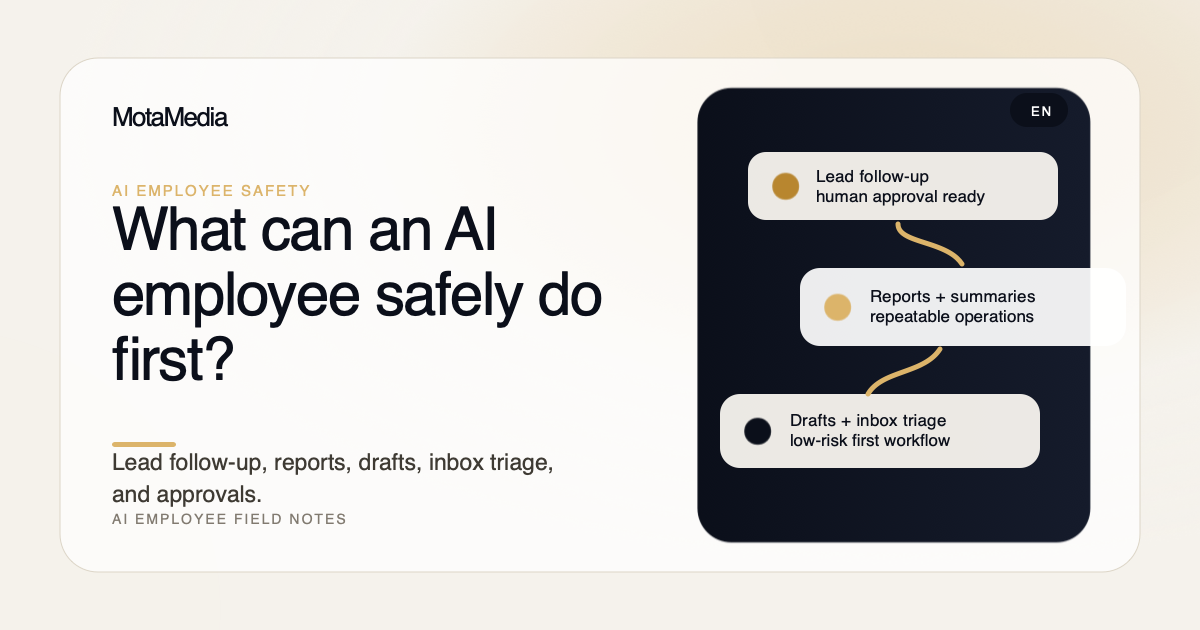
An AI employee can safely support a marketing agency by preparing recurring, rule-based work that a person can review quickly: transcript summaries, content drafts, briefs, inbox triage, reporting summaries, onboarding checks, and reminder drafts. The workflow should use approved source material, limited permissions, and a named owner. Client-facing publication or sending, payments, commitments, permission changes, and sensitive-data transfers should stop at a human approval gate.
Start with the agency’s operational tail
The best first workflow is usually not the creative decision that defines the campaign. It is the coordination work around that decision: organizing approved inputs, preparing a first draft, checking completeness, and moving a reviewed output to the next step.
This boundary matters for marketing and content agencies. A useful AI employee can reduce preparation work without pretending to replace creative judgment, account leadership, or the person responsible for a client commitment.
Six safe first AI workflows for agencies
- Transcript to content inputs: turn an approved meeting transcript into a summary, action list, buyer questions, and reusable content inputs.
- Platform-specific draft preparation: prepare social copy, article outlines, email drafts, or captions from approved source material. A person still approves the final message and destination.
- Briefs and checklists: assemble a content brief, production checklist, asset list, or handoff document using a defined template.
- Inbox triage: classify agency requests, flag urgent items, and propose replies without sending them.
- Reporting summaries: organize approved data inputs into a recurring summary and surface anomalies for a human to investigate.
- Onboarding completeness: identify missing inputs, prepare reminders, and show the account owner what is blocking kickoff.
These examples describe preparation and internal coordination. They do not promise autonomous outcomes, error-free execution, or suitability for every client and tool.
The Mota Agency Workflow Gate
The Mota Agency Workflow Gate is a five-part test for deciding whether an agency workflow is ready for AI assistance:
- Approved source: the workflow begins with material the agency is allowed to use.
- Bounded scope: the job, expected output, prohibited actions, and stop conditions are explicit.
- Preparation: the AI drafts, classifies, summarizes, or checks; it does not silently expand its role.
- Human review: a named person checks accuracy, context, brand fit, and client risk.
- Authorized release: only the approved output moves to the approved destination.
A safe agency AI workflow separates preparation from authority: the AI prepares the next step, while a named person controls the commitment.
Example: transcript to approved content brief
- An approved client or internal transcript enters the workflow.
- The AI prepares a factual summary, action list, audience questions, and content-brief draft.
- The account or content owner reviews the source references, removes anything unsuitable, and corrects the brief.
- Only the approved brief moves into the next writing or production tool.
This same pattern can support a LinkedIn-to-blog workflow: source first, draft second, review third, publication last.
Where human approval still matters
A human gate is required when the next action creates an external commitment or meaningfully changes access, money, reputation, or client risk.
- Publishing or sending client-facing content, messages, or deliverables.
- Approving pricing, proposals, contracts, refunds, invoices, or payment instructions.
- Changing permissions, credentials, connected applications, or automation rules.
- Making legal, medical, HR, financial, or other high-stakes decisions.
- Transferring sensitive data to a person, platform, or model that has not been approved.
Use least-permission design
Match access to the role. A draft-preparation agent does not need publishing credentials. A transcript workflow does not need billing access. A reporting assistant should only read the approved data sources required for its report.
Least permission limits the consequence of a mistake and makes review easier. It is a design boundary, not a claim that any system is risk-free or automatically compliant.
First-workflow scorecard
A candidate workflow is stronger when the agency can answer yes to these questions:
- Does the task recur often enough to justify a repeatable system?
- Are the source of truth, rules, and expected output already clear?
- Can a named owner review the output quickly?
- Would an error have a limited and manageable impact before release?
- Are the necessary source inputs available and approved?
- Is there an explicit escalation path when the AI is uncertain?
- Can the workflow run with limited permissions?
- Can the agency measure operating value without inventing an outcome?
If several answers are no, simplify the workflow before adding more access or autonomy.
Questions to answer before implementation
- What exact job is the AI responsible for?
- What is the approved source of truth?
- Which tools may it use, and which are prohibited?
- What permission level does the job actually require?
- Where must the workflow stop for approval?
- What happens when the source is missing, ambiguous, or contradictory?
- Who owns the review and escalation?
- What measurable operating signal will show whether the workflow is useful?
What this approach does not guarantee
A reviewable workflow does not guarantee accuracy, security, compliance, savings, revenue, rankings, or client outcomes. The agency remains responsible for its source material, permissions, review standard, destination, and legal or contractual obligations. Start with a narrow job, test it against real examples, and expand only when the evidence supports the next step.
Method, source, and update date
This guide documents Mota Media Marketing’s agency workflow design method: approved inputs, bounded preparation, human review, and an authorized next step. It was materially updated on July 23, 2026 for marketing and content agencies in Canada, including Québec. It contains no client-result claim and does not replace legal, privacy, security, HR, medical, or financial advice.
For the content side of the system, see how clear answer blocks support buyer understanding without requiring special “AI schema.”
Want to map a safe first agency workflow?
We can map the job, source, tools, permissions, approval point, failure path, owner, and launch measure before anything goes live.
Book a Free Consult →